

How Far Can a Private Jet Fly? Range by Aircraft Class, Explained
The brochure says 3,500 nautical miles. Your actual Tuesday says less. How range really works, class by class - and when the fuel stop is the smarter buy.
Bravo Editorial Team/August 23, 2026/Updated September 23, 2026/5 min read
"Can it make it nonstop?" is the second question every charter conversation reaches, right after price. The answer printed in the brochure is a number achieved by a lightly loaded aircraft flying an ideal profile in cooperative weather. The answer that matters, with your passenger count, your winter headwind, your alternate-airport requirements, is always somewhat less, and knowing roughly how much less is the difference between planning a trip and re-planning one at the fuel stop.
Here's range by class, what erodes it, and how professionals actually think about the nonstop question.
Range by Class: The Realistic Picture
| Class | Brochure range | Realistic nonstop missions | Example aircraft |
|---|---|---|---|
| Turboprop | ~1,000–1,800 nm | Regional legs, island hops | King Air 350, PC-12 |
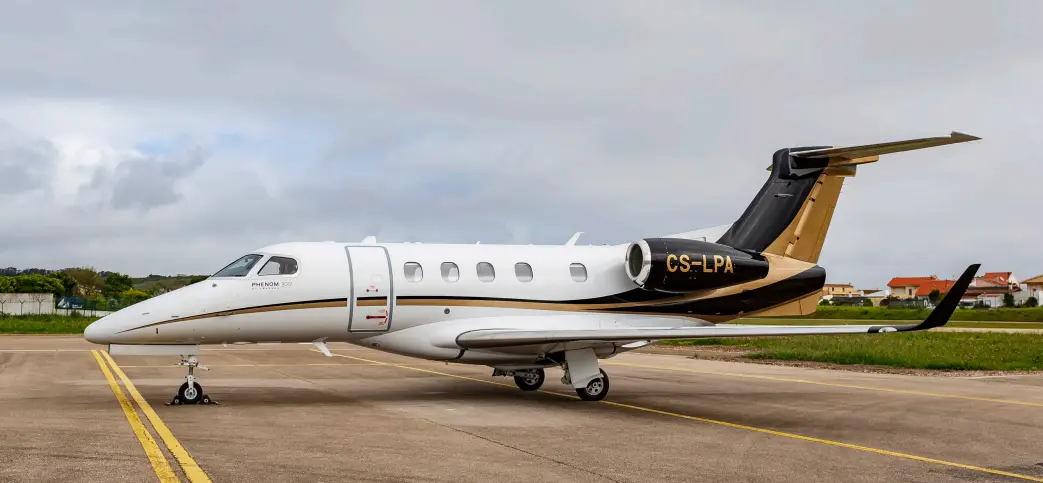
| Light jet | ~1,200–2,000 nm | NYC–Florida, LA–Dallas | Phenom 300, CJ3 |
| Midsize | ~2,000–2,700 nm | Transcon with favorable winds | Citation Latitude, XLS |
| Super-midsize | ~3,000–3,500 nm | Coast-to-coast reliably, into Hawaii range | Challenger 350, Longitude |
| Heavy | ~4,000–6,000 nm | US–Europe nonstop | Gulfstream G450, Falcon 7X |
| Ultra-long-range | ~6,500–7,700 nm | Any two cities on most continents | G550, Global 7500 |
The named ranges are manufacturer figures under NBAA-style reserve assumptions; the "realistic missions" column is what operators actually plan day in, day out. The Global 7500's published 7,700 nautical miles genuinely covers New York to Hong Kong; a light jet's published 2,000 covers New York to Los Angeles only on a good day with a light load, which is why dispatchers treat that trip as fuel-stop territory.
What Shrinks the Brochure Number
Four factors, in rough order of impact:
- Wind. The jet stream runs west to east at up to 150+ knots in winter. A transcon that's five hours eastbound can be six-plus westbound, and range planning must carry the difference. Winter westbound is when marginal nonstops become fuel stops.
- Payload. Brochure range typically assumes four passengers. Fill eight seats and their luggage and the fuel that can't come along is range you don't have. This bites hardest at the light and midsize end.
- Reserves and alternates. Legal planning requires fuel to a destination, an alternate, plus reserves. Bad weather at the destination means a distant alternate, subtracting real range from the same tanks.
- Runway and altitude. A hot day at a high-elevation field like Aspen or Eagle County limits takeoff weight, which means less fuel, which means less range. Mountain departures routinely carry fuel-stop asterisks in summer heat too.
“Operators plan range the way sailors plan water: for the day you don't get, not the day you hope for.”
The Fuel Stop, Reconsidered
Charterers dread fuel stops more than they should. The honest accounting: a planned tech stop costs about 45 minutes to an hour ramp-to-ramp, the aircraft lands, fuels with passengers comfortable aboard or stretching their legs, and departs. No security, no terminal, no connection risk.
That reframes the class decision on marginal routes. New York to Los Angeles in a light jet with a stop can cost dramatically less than nonstop in a super-midsize, for a one-hour penalty. For a family repositioning for a month, that trade often makes sense; for a same-day round-trip negotiation, it never does. The point isn't that stops are good; it's that nonstop is a product feature with a price, and you should buy it deliberately. Price both structures in the cost estimator and the trade becomes a number instead of a fear.
Two cases where the stop is strictly worse: trips where total time is the whole point, and international routings where an extra landing adds handling fees and customs complexity rather than just minutes, the calculus our Europe guide walks through for Atlantic crossings.

Three Range Myths Worth Retiring
"The brochure lied." No, it answered a different question. Published range figures follow standardized assumptions (typically four passengers, long-range cruise, NBAA reserves) precisely so aircraft can be compared apples-to-apples. The number is honest; it's just a benchmark, not a promise about your trip. The gap between benchmark and mission is what flight planning is for.
"Bigger is always safer for range." Upsizing buys margin, but the priced question is whether your actual missions need it. A flier whose longest regular leg is 1,800 nautical miles pays for nothing by chartering super-midsize every week when a midsize covers the mission ten months a year, the smarter pattern is class-matching per trip, upsizing only for the outlier legs. Charter's whole advantage over ownership is that you can.
"A fuel stop means something went wrong." Planned tech stops are a routine tool, not a failure state. Dispatchers choose stop airports for fast turnarounds and cheap fuel, crews brief them in advance, and the schedule carries them from the start. The stop that hurts is the unplanned one, which is exactly what honest load numbers and conservative planning exist to prevent.
The thread through all three: range management is the operator's core competency, practiced daily. Your job isn't to master it, it's to supply true inputs and pick operators, per our vetting guide, who plan like professionals.
Matching Range to Mission (Not Ego)
The range conversation is really an aircraft-class conversation, and the practical guidance compresses well:
- 01Under 1,000 nm: everything flies it. Choose on cabin, price, and runway, often the turboprop-vs-jet question, not the range question.
- 021,000–2,000 nm: light jets work with honest load math; midsize buys comfort margin. Watch winter westbound.
- 03Transcon: super-midsize is the no-asterisk answer; midsize works with cooperation from the winds; light jet means embracing the stop.
- 04Ocean crossings: heavy iron territory. US East Coast to Western Europe is routine for the heavy class; deeper missions belong to the ultra-long-range flagships.
- 05The "almost" routes are where expertise pays. Missions that sit at 90% of an aircraft's range are exactly where operator experience, seasonal winds, and load discipline decide between nonstop and not. Say the real passenger count and luggage up front in your quote request, and let the operator plan the airplane around the truth.
Browse the full aircraft-type directory for per-type range, speed, and cabin data, every profile carries the numbers this article speaks about in classes.
The Bottom Line
Range questions reward honesty in both directions: honest about the load you're really carrying, and honest about what an hour of your time is really worth. Get those two numbers right and the aircraft class usually picks itself; get them wrong and you either overpay for range you never use or plan a nonstop your load can't fly. The brochure figure goes back to being what it always was: the best day, not the plan.
Keep reading
All posts → Industry Explainers
Jet Card Deposits: Where Your Money Actually Sits
Most jet card deposits are working capital the day they land, not escrowed funds. Where your balance really sits, and how to protect it.
5 min read
 Industry Explainers
ARGUS Platinum Operators: Who Has the Highest Safety Rating
Only 38 operators worldwide hold ARGUS Platinum. Here is what makes the rating so difficult to earn and which operators on the Bravo register have it.
8 min read
 Industry Explainers
Difference Between ARGUS Gold and Platinum Safety Ratings
When does ARGUS Gold matter, when does Platinum matter, and how should charter buyers use these ratings to make informed decisions?
7 min read
Ready when you are
Compare rated operators on your route
One request, multiple itemized quotes from audited Part 135 operators, with reviews and safety ratings beside every name.